For this example, we’ll assume that the stage manager has worked a basic 54-hour week, including 4 hours of cueing, that the salary is $1000/wk and that they are working in a province where the overtime threshold is 44 hours.
Let’s also assume that the hours broke down this way:
- Rehearsal — 42 hours
- Prep — 8 hours
- Cueing — 4 hours
In this case, there would be no CTA overtime payable for the rehearsal hours, since these would not have exceeded the hours available for the actors. Nor would there be CTA overtime for the prep, since prep did not exceed the basic allowance.
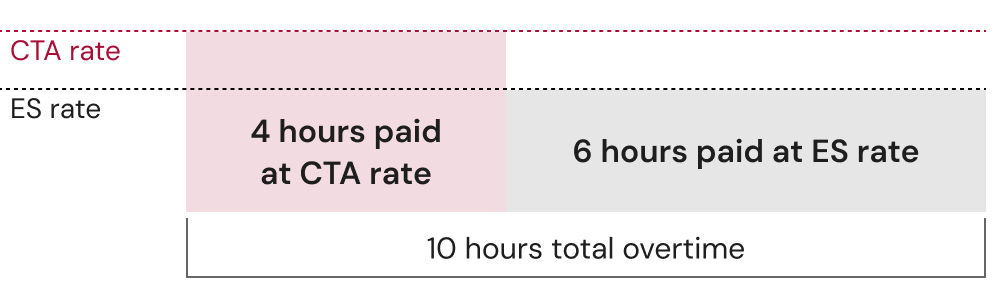
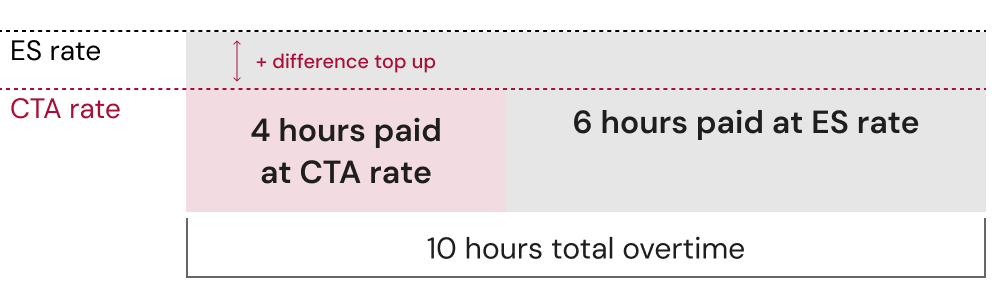
CTA overtime would be payable for the 4 hours of cueing, since these would have exceeded the hours available for the actors. Therefore, CTA overtime for this week would be $162.25 for four hours (1 half-hour at $17.00 + 7 half-hours at $20.75).
Since ES overtime is calculated on the total work hours per week, ES legislation would require payment for 10 hours. Four hours would already have been paid according to the CTA, and at a higher rate, so the remainder owing would be 6 hours at the ES rate of $34.09, totaling $204.54. Total overtime actually paid, from both sources, is $366.79.